My first week back after the Christmas holidays was mostly taken up with travelling to and attending a workshop in Zurich hosted by the ‘Waxing and Waning Words: Lexical Variation and Change in Middle English’ project (https://www.waw-me.uzh.ch/en.html). This project will be producing a Middle English thesaurus comparable to the Bilingual Thesaurus of Everyday Life in Medieval England (https://thesaurus.ac.uk/bth/) that I was responsible for developing back in 2018, and over the past year or so I’ve been helping out the project’s developer by sharing the BTH code, some sample data, and discussing how it all interoperates.
The workshop was a great opportunity to meet the project team and to work with their developer Tony Harris in person. Working together in person is considerably more effective than communicating by email or even via online video calls and it was hugely productive. We spent at least a day of the day and a half workshop working together and Tony’s knowledge and understanding of the system and its data structures increased massively during this time. We worked with an initial dataset that the project team has created for the semantic domain ‘law’ and by the end of the first day we had created a pathway for importing this data into the thesaurus structure, meaning it could be searched and browsed in the same way as the BTH. We also created links out from the headwords to the Middle English Dictionary. Tony was then able to then apply this workflow to another semantic domain (medicine) and was able to demonstrate a working online resource to the other workshop participants the following day. He should now have everything he needs to process the project’s data an integrate it into the thesaurus as the project proceeds.
It was great to be back in Zurich again, having attended a workshop there some three years previously, but our journey to and from Zurich did not go at all smoothly this time, due to some rather severe weather conditions. There are no direct flights from anywhere in Scotland to Zurich so we had to change flights at Heathrow. Unfortunately due to delays we missed our connecting flights both on the way out (on Tuesday) and the way back (on Thursday), which made for a lengthy and rather stressful journey. This was especially bad on the return journey as our connecting flight was the last flight of the day from Heathrow to Glasgow, meaning we had to stay overnight in London and get an early flight back on Friday morning. This was all pretty exhausting, but we did at least finally get back to Glasgow safely and despite the travel difficulties the workshop was worth it.
I only had time on Monday and Friday afternoon to work as usual this week, and some of Monday was taken up preparing for my trip. However, I did manage to get a few things done. In the run-up to the Christmas holidays I’d been working with the Hansard frequency data and at the start of the holidays I spent some time writing and executing a script to output the data for each year (199 years from 1803 to 2004, with some gaps) as a separate CSV file. I tweaked the data a bit to change the three-character month text to an integer, as this makes it easier to order the data by month (e.g. so ‘apr’ doesn’t come first). It also saves some space. I set the script running overnight and it had completed by the morning. It turns out we only have Commons data and nothing for Lords, with the 199 CSV files taking up 37.6GB (although when zipped this drops to 5GB). I uploaded this to Teams so Marc and Fraser can access it.
On Monday I wrote a further script to export the remaining metadata tables from the Hansard database running on my laptop. These tables contain information about speeches, speakers, parties, roles etc, and are connected through to the frequency data via the speech filename. My scripts exported these tables as CSV files and I added them to Teams too. They should be useful in allowing the frequency data to be limited to a speaker or group of speakers, or a particular political party and such things.
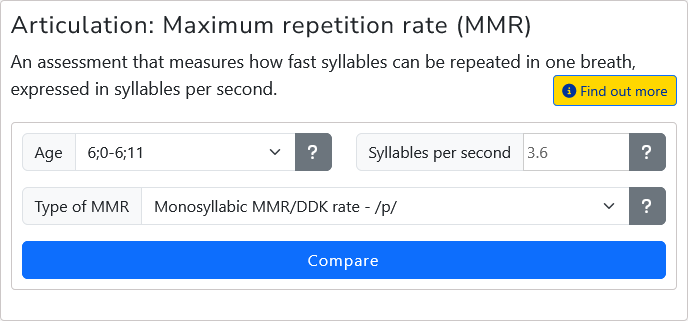
Also on Monday I spent a bit of time working on the VARICS project. Before Christmas I was sent some further data for the lookup feature I’ve developed for the project, this time for maximum repetition rate. It took quite a while to get this working as the new data has a different structure to previous lookup types. Once selected the type then has several subtypes, such as ‘Monosyllabic MMR/DDK rate – /p/’ so I needed to ensure a further selection was added to the interface and also that this was taken into consideration when the data was being queried. The data itself also included several new fields for ‘coefficient of variation’ that also needed to be stored and displayed.
I decided to create a new table to this new data type, populated it with the data from the spreadsheet I’d been sent and created new display and measurement analysis code for the new type. The new display for the speech measure can be seen below:
When I returned to work on Friday afternoon I made some tweaks to the metadata for the Speech Star ‘MRI Modelled Speech Corpus’ (https://www.seeingspeech.ac.uk/speechstar/mri-speech-corpus/) that Eleanor Lawson had asked me to make. I also began to investigate updating the BTH display of lexemes to add in options to order them by date and length of attestation in addition to alphabetically by headword, something we offer through the main Historical Thesaurus and we’d discussed at the workshop. I wrote a script to generate the length of attestation and will hopefully implement the ordering options next week.
I also investigated an issue someone at the workshop spotted with some of the BTH lexemes having start dates later than their end dates. It turns out that there are 197 such lexemes, which I exported as a spreadsheet and sent to Louise Sylvester for checking. Hopefully it’s a simple case of the start and end dates getting accidentally added the wrong way round and a simple switch will sort things.


